I've had a pretty crazy few weeks. Selling our old location in Downtown Denver, finding two new spaces (one short-term, and our new “forever home”), and moving all the shit my business and I have accumulated over the years. On top of that, I'm building out the new space to the vision I've had in my head for a very long time.
It's all incredibly exciting and positive stuff, but it's a lot of work. With that extra work and stress on top of running the business, my body has been screaming at me a bit!
It's been sending me signals of stress and pain every day. For me, that shows up as:
- tight, painful hips
- a tight low back
- shallow breathing
- poor sleep
- a little less energy at the end of the day
They say you build what you need the most, and for me that's been very true. What we've built at KORU over the past two years is exactly what I needed for a very long time. The biggest one of those is the ability to control my nervous system, so I can make better decisions about how I show up emotionally. Because that's my responsibility.
One of the biggest shifts I've made is how much more resilient I am now to stress, whether it's mental, emotional or physical. I want to share a few tools I use daily.
1. Body scan
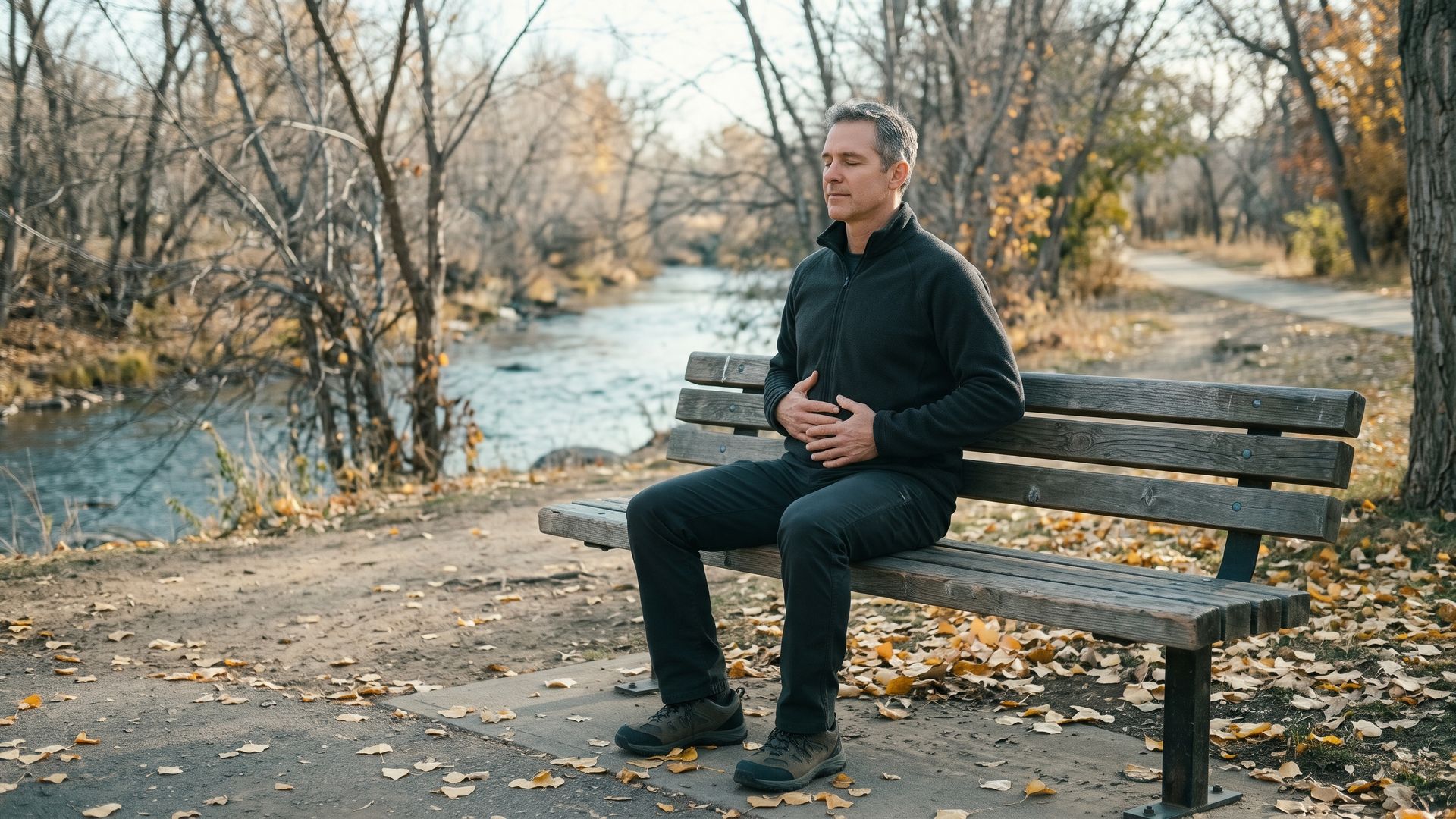
Where are you holding stress or tension in your body right now? I pause, slow my breath, close my eyes, and scan slowly from head to toe. When I find tension (which I always do), I pause there, acknowledge it, breathe into it, and let it release. For me it tends to sit in my jaw, traps and hips.
2. Where am I breathing?
Am I breathing into my chest and shoulders, or using my diaphragm? In and out of my mouth (the dreaded mouth breather!!), or through my nose? Fast and shallow, or long and slow?
If needed, I shift my breath to low and slow, using my diaphragm and nasal breathing only.
3. Self-talk and mantras
What's my internal dialogue right now? Am I being kind to myself, or am I in negative self-talk? For me, that sounds like “you're not good enough,” “no one cares,” or “you don't deserve this.” It's improved a shit ton over the past few years, mostly by using these tools. Now I replace that chat with mantras like:
- “I'm safe here.”
- “I'm exactly where I'm supposed to be.”
- “I am loved.”
These are three pretty simple, quick things. The challenge is using them when we're actually under stress.
Even just noticing when you're holding tension, when your breath changes, or what your internal messaging is saying is a great place to start.
I'd love to hear what you notice about yourself. I've seen such a massive shift in my own world since using these strategies, so if you have any questions at all, please reach out.